Read the current warning
June explains the move from 9.1 to 9.2 and why the Red Zone is deepening rather than stabilizing.
Open latest analysisStart with the latest shift, then follow the evidence, the score movement, and the practical civic response.
At this level, the danger is no longer only cumulative erosion. Institutional failures can now emerge suddenly, cascade faster, and become harder to reverse.
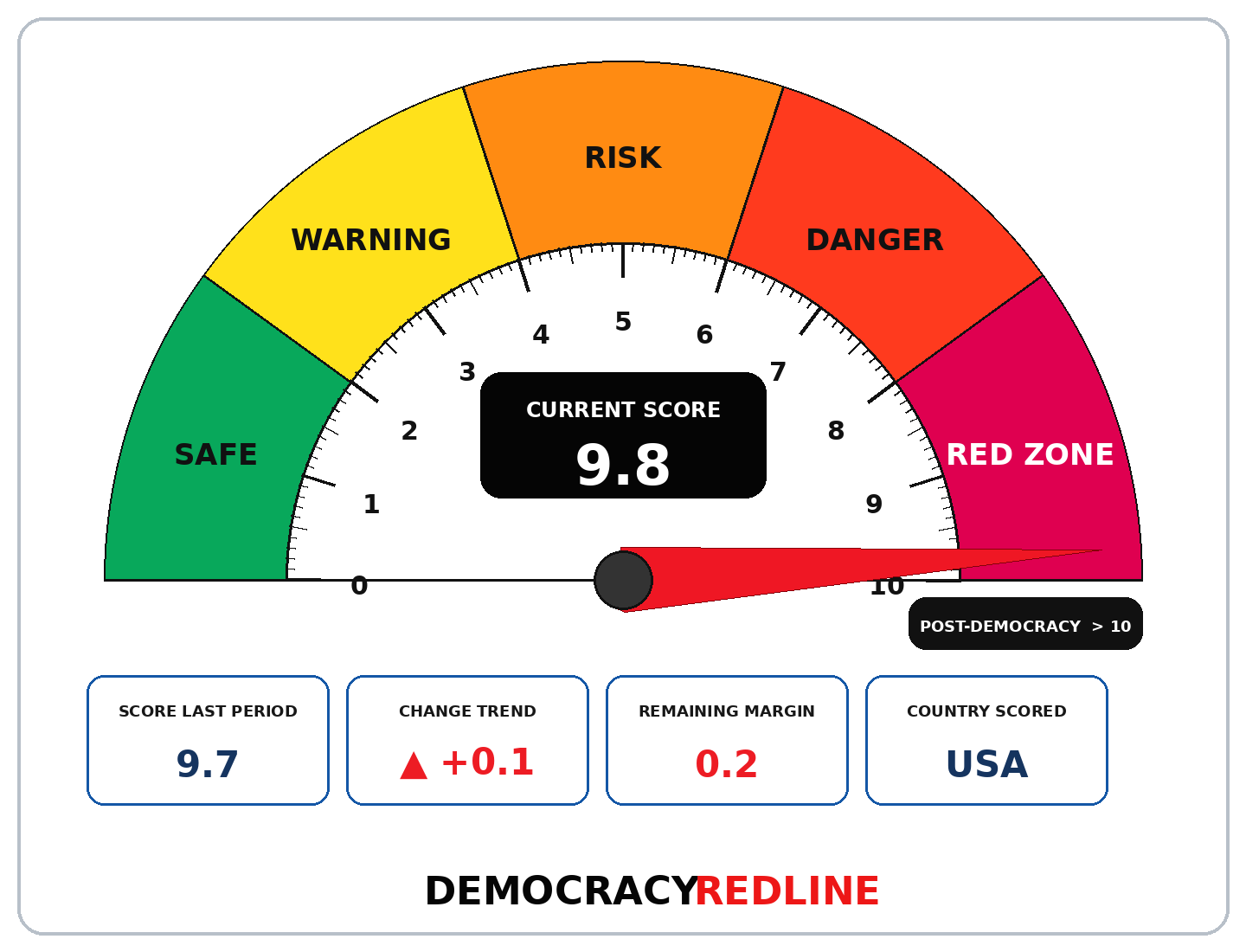
June deepened the Red Zone again. Election structure, due process, coercive state power, and military-intelligence neutrality all worsened further, even while courts still imposed partial resistance.
June explains the move from 9.1 to 9.2 and why the Red Zone is deepening rather than stabilizing.
Open latest analysisThe methodology and evidence spine explain what counts, what does not, and how public evidence becomes a monthly risk score.
Open methodologyThe Action Toolkit turns concern into focused civic behavior: verify, contact, support, document, and share carefully.
Open action toolkitThe score rose from 9.1 to 9.2 because several already-damaged safeguards worsened at the same time.
See the score driversElection structure, due process, coercive state power, institutional oversight, and military-intelligence neutrality are no longer separate stories.
Compare the timelineThe evidence hub documents the source standards and the monthly developments that carried the most weight.
Open the evidence spineRead carefully, verify claims, support watchdogs, contact officials, protect lawful participation, and share without exaggeration.
Start with one action
May established the prior Red Zone baseline. June moved the warning higher because stress spread across more than one core safeguard.
The largest concern is not a single category. It is the pattern of categories deteriorating together.
Courts, watchdogs, civil society, and public documentation still provide friction. They slowed some damage, but did not reverse the overall direction.
Review countervailing signalsThe score is grounded in public records, court actions, official statements, watchdog reports, major journalism, election administration sources, civil liberties sources, and democracy-index references.
Open the evidence spine · Open the methodology · Publishing standard
The formal report carries the same 9.2 score, top drivers, category scorecard, historical trend, and source-credibility framing in a printable format.
June shows the current Red Zone condition. May preserves the prior deepening month, and April preserves the month when the index first crossed the threshold.
Election structure, court compliance, due process, and war-powers oversight all worsened together rather than in isolation.
The judiciary continues to impose real friction, but mostly as braking pressure rather than full reversal.
At 9.2, each month of unresolved stress makes subsequent institutional failures easier to normalize and harder to undo.
Track state election changes, oversight votes, and court-compliance stories locally, not just nationally.
Connect isolated incidents into patterns of institutional stress and explain why the pattern matters.
Prioritize cases involving compliance, detention access, election administration, and press access.
Translate procedural changes into plain English so people understand what is actually being lost.
| Indicator | Status |
|---|
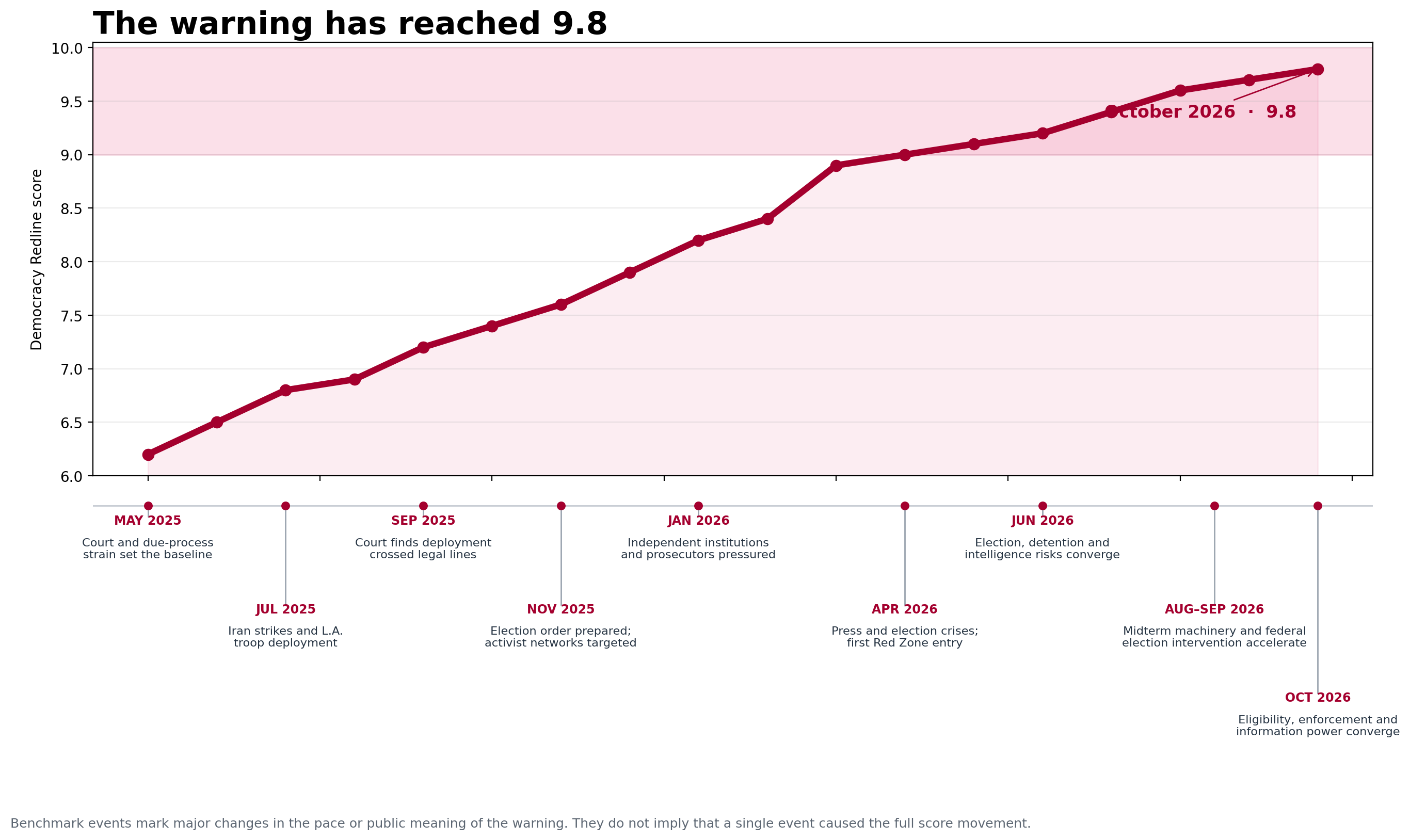
This chart tracks the published monthly score path through June 2026 and flags benchmark events that changed the pace or public meaning of the warning.
It shows accumulation. Democratic danger grows through sequence, not only spectacle.
June adds Alabama map reinstated as the latest threshold marker affecting the score path.
Open the full June analysis to see why the score moved from 9.1 to 9.2.
The U.S. moved from 9.1 to 9.2 because June worsened already-damaged categories: election integrity, due process, coercive state power, and military-intelligence neutrality. Courts still pushed back in important places, but mostly as restraint rather than reversal.
Democracy Redline is not designed to replace primary-source review. It is designed to translate complex institutional erosion into a visible public warning that is harder to ignore and easier to compare across months.
The evidence hub explains what counts, what does not, and which June developments carried the most weight in the move from 9.1 to 9.2.
Read plain-English civic explainers, propaganda autopsies, argument-fallacy lessons, political cartoons, and sharp satire aimed at the slogans that help normalize democratic decline.
The goal is not to scare people into noise. It is to help people recognize democratic stress early enough to respond with lawful, evidence-based civic pressure.