1) The Election Assistance Commission purge
Very highThe removal of the remaining commissioners converted an abstract removal-power ruling into direct control over a core election-support institution.
July moved the score from 9.2 to 9.4 as election administration, agency independence, press freedom, prosecutorial neutrality, statutory compliance, and war-powers accountability came under simultaneous pressure.
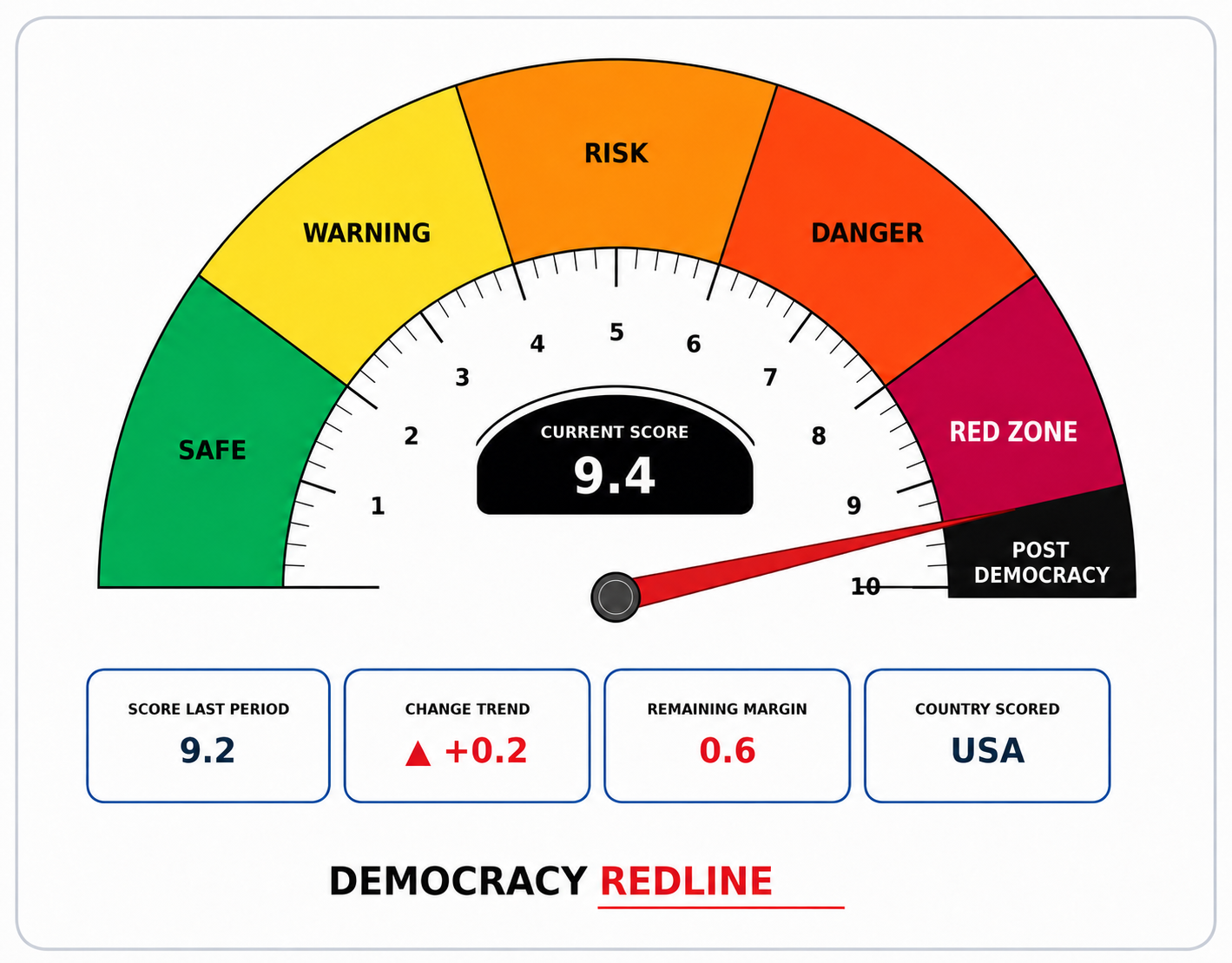
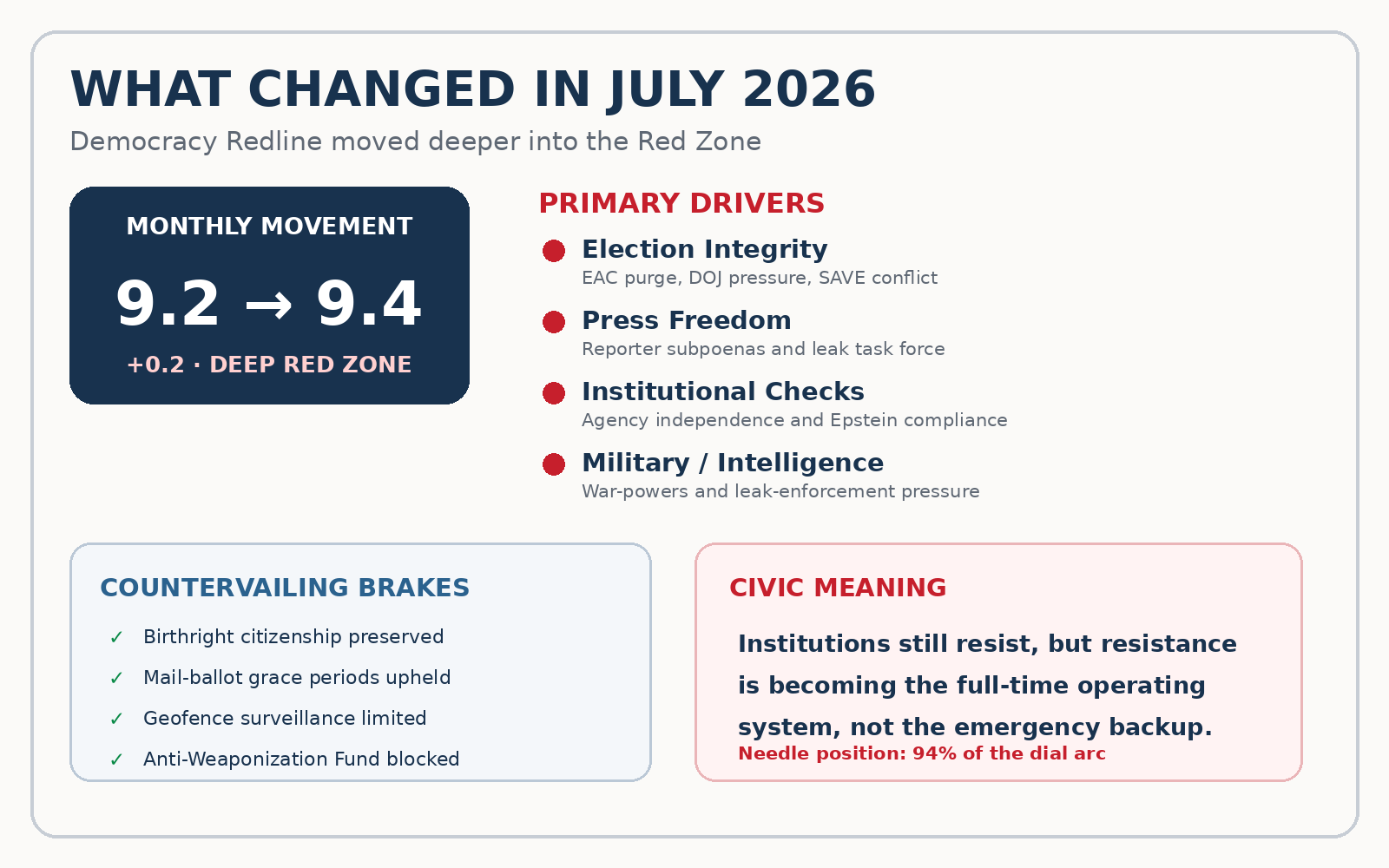
July moved Democracy Redline from 9.2 to 9.4. The administration removed the remaining Election Assistance Commission members, DOJ warned state election officials about possible criminal liability, journalists were subpoenaed in a federal leak investigation, and the Pentagon joined DOJ in a coordinated leak-prosecution initiative.
At the same time, the Supreme Court substantially expanded presidential removal power over independent agencies, DOJ resisted additional Epstein-file disclosure after a statutory mandate and federal order, and military hostilities resumed despite congressional efforts to reassert war-powers authority.
Courts and other institutions still imposed real restraints. Birthright citizenship was preserved, state mail-ballot grace periods survived, geofence surveillance was limited, the Anti-Weaponization Fund was dismantled, and Pentagon press restrictions were blocked. Those checks matter. They did not outweigh the broader direction.
The score moved from 9.2 to 9.4 because election administration, press freedom, agency independence, transparency compliance, and war-powers accountability deteriorated together.
The removal of the remaining commissioners converted an abstract removal-power ruling into direct control over a core election-support institution.
DOJ introduced prosecutorial threat into voter-roll and election administration traditionally managed by state and local professionals.
The subpoenas threatened confidential-source protection, while the joint DOJ-Pentagon initiative suggested institutional escalation.
DOJ declined additional production after a statutory mandate and judicial order. No contempt finding has been verified, but the substantive compliance dispute is significant.
Congress sought to reassert war-powers authority, but hostilities resumed without a stable constitutional settlement over authorization.
Election administration faced direct executive pressure through the EAC purge, DOJ prosecution warnings, federal funding conditions, and conflicting SAVE database orders.
Birthright citizenship survived, but presidential removal power expanded and DOJ entered a major statutory and court-order compliance dispute over Epstein records.
The Court narrowed practical review and access in TPS and asylum cases while the detention-and-bond conflict remained unresolved.
Geofence surveillance was limited, but aggressive immigration enforcement and centralized control of enforcement bodies kept the category moving upward.
The Anti-Weaponization Fund was stopped, yet prosecutorial pressure on election officials and journalists kept weaponization risk at an extreme level.
Reporter subpoenas, the joint leak task force, and field assaults sharply increased the cost of adversarial reporting.
The environment remains hostile, but verified July evidence did not justify another category-specific increase.
A judge dismantled the fund, but agency independence weakened and transparency compliance required escalating institutional intervention.
Congress asserted war powers, but hostilities resumed and national-security institutions became more involved in politically sensitive leak enforcement.
July was not a story of complete surrender. The Supreme Court preserved birthright citizenship, protected state authority over timely cast mail ballots, and limited geofence surveillance. A federal judge dismantled the Anti-Weaponization Fund. Courts protected Pentagon press access. Congress invoked war-powers authority. Georgia officials resisted additional redistricting. Wisconsin continued its fake-elector prosecution.
The problem is that these safeguards are increasingly reactive. The system is defending itself later in the sequence, after more damage or institutional pressure has already accumulated.
An independent monthly warning system tracking democratic stress in the United States.