America’s democratic safeguards are still holding. The effort to disable them is accelerating.
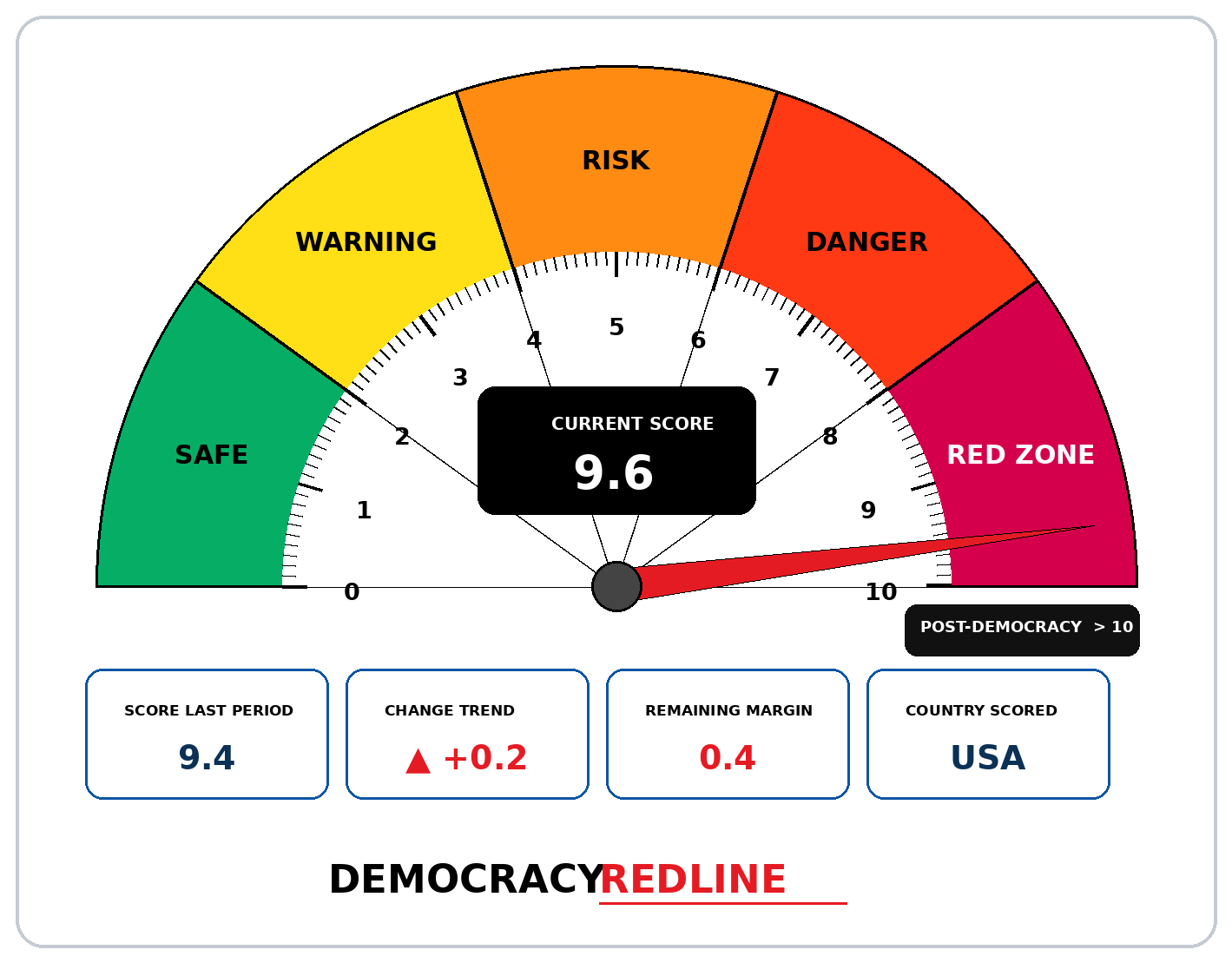
After more than a year of sustained institutional pressure, the index has reached 9.6, its highest score to date, as election administration, intelligence, Justice Department accountability, independent information, and coercive enforcement come under converging pressure.
Executive summary
August did not produce one definitive constitutional rupture. It produced a convergence. The institutions that administer elections, investigate misconduct, produce intelligence, protect information, and enforce legal limits are increasingly pressured at the same time.
President Trump removed the remaining bipartisan Election Assistance Commission leadership. DOJ warned election officials nationwide of possible criminal liability and continued demanding sensitive voter information despite 21 consecutive court defeats. Selectively declassified intelligence was then used to support a contested election narrative. At the same time, DOJ watchdog capacity weakened, Todd Blanche was confirmed as attorney general after controversy over arrangements benefiting Trump and his allies, and press access and media pluralism narrowed.
Safeguards remain functional, but increasingly as emergency response systems confronting completed executive actions rather than durable boundaries preventing those actions.
Recommended category scorecard
| Category | July | August | Move |
|---|---|---|---|
| Election Integrity | 9.5 | 9.8 | +0.3 |
| Rule of Law & Court Compliance | 9.6 | 9.7 | +0.1 |
| Habeas Corpus & Due Process | 9.6 | 9.7 | +0.1 |
| Coercive State Power | 9.2 | 9.4 | +0.2 |
| Weaponized Justice | 9.6 | 9.8 | +0.2 |
| Press Freedom | 9.4 | 9.6 | +0.2 |
| Civil Society | 8.4 | 8.6 | +0.2 |
| Institutional Oversight | 9.4 | 9.7 | +0.3 |
| Military / Intelligence Neutrality | 9.2 | 9.4 | +0.2 |
The unrounded weighted result is approximately 9.57, published as 9.6.
1. Election Integrity & Peaceful Transfer
9.8The remaining Election Assistance Commission leadership was removed, DOJ warned election officials of possible criminal liability, and the administration continued a nationwide voter-file campaign despite 21 consecutive court defeats. Selectively declassified intelligence was then used to renew claims that the 2020 election was compromised. State resistance and judicial review remain strong, but neutral federal election support has been materially weakened.
2. Rule of Law & Court Compliance
9.7Courts repeatedly imposed real limits, yet the government forced judges to defend boundaries through serial litigation. DOJ professional-responsibility capacity declined as misconduct complaints rose, leaving courts to carry more of the accountability burden. Judicial authority remains enforceable, but voluntary compliance and internal correction are less reliable.
3. Habeas Corpus & Due Process
9.7The first operational use of the Alien Terrorist Removal Court moved a national-security removal case into an unusually secretive forum. Mandatory detention, airport arrests, bond-hearing disputes, and expression-linked immigration enforcement added pressure. Courts still hear habeas claims and sometimes order release.
4. Coercive State Power
9.4Two fatal ICE shootings involved people whom agents were not initially seeking. The public record does not yet establish criminal wrongdoing by individual agents, but mistaken identity, disputed official accounts, enforcement intensity, and weakened oversight form a serious systemic warning.
5. Weaponized Justice
9.8Todd Blanche was confirmed as attorney general after controversy over a proposed $1.8 billion compensation fund for Trump allies and an arrangement affecting Trump-family tax audits. Senate concessions demonstrated remaining leverage, while the underlying proposals, leak investigations, and election-official warnings deepened concern that justice power is being personalized.
6. Press Freedom
9.6DOJ withdrew defective subpoenas to New York Times reporters after judicial scrutiny, but the leak investigation continued. Pentagon access restrictions remained in place, and the FCC removed the national television ownership cap. Formal publication remains free, while source protection, access, and media pluralism are less secure.
7. Civil Society
8.6A judge blocked the VA’s third effort to terminate a union agreement covering roughly 320,000 employees. Immigration and visa powers continued to affect political expression and association. Courts remain a meaningful counterweight, keeping this category below 9.0.
8. Institutional Oversight
9.7DOJ’s Office of Professional Responsibility and inspector-general capacity weakened as allegations increased. The proposed compensation and tax arrangements illustrated personalized-governance risk. Congress extracted concessions and continued oversight, but durable consequences remained inconsistent.
9. Military / Intelligence Neutrality
9.4Intelligence deteriorated more sharply than the uniformed military. Declassified material was used in an election narrative, ODNI personnel were cut under inexperienced acting leadership, and the incoming DNI declined to affirm the certified 2020 result. The armed forces remain professional, outside electoral administration, and subject to courts.
The August failure pathway
- Neutral election-support officials are removed.
- Election administrators face criminal warnings.
- Federal agencies demand sensitive voter information.
- Courts reject the demands, but appeals continue.
- Intelligence is selectively released to portray elections as compromised.
- DOJ leadership and internal accountability become more personally aligned.
- Journalism encounters source investigations, access controls, and ownership concentration.
- If the midterm result is unfavorable, the administration possesses a preconstructed narrative and institutional machinery with which to challenge it.
The final step has not occurred. Several preceding steps are demonstrated actions.
Why 9.6, not 9.7 or 9.8
Competitive elections remain scheduled. Election administration is decentralized. Opposition parties, state governments, courts, journalists, civil society, congressional resistance, and a professional military remain operational. A higher score would leave too little analytical space for open defiance of final court orders, mass political imprisonment, cancellation or nullification of election results, systematic closure of independent media, or partisan operational use of the military.
The system remains operational. Its remaining safeguards are now operating inside the conflict rather than safely outside it.
Why this moment requires a Special Report
Democracy Redline was designed to identify cumulative danger before a spectacular crisis made the warning obvious. The question now is whether the United States is approaching an election that will be administered normally, but accepted only conditionally.
Selected sources
- EAC commissioners removed — Reuters
- EAC scrutiny before dismissals — Reuters
- DOJ criminal warnings to election officials — Reuters
- Twenty-one voter-file court defeats — Reuters
- Election-security address — Reuters
- Election speech fact-check — FactCheck.org
- DOJ watchdog capacity — Reuters
- Blanche confirmation — Reuters
- Alien Terrorist Removal Court — Reuters
- Badar Khan Suri ruling — Reuters
- Fatal immigration-enforcement encounters — Reuters
- New York Times subpoenas — Reuters
- Pentagon escort policy — Reuters
- Television ownership cap — Reuters
- FCC ownership decision — FCC
- VA union ruling — Reuters
- Visa revocations — Reuters
- Iran war-powers votes — Reuters
- DNI nominee testimony — Reuters
- Wind-project ruling — Reuters
- White House ballroom ruling — Reuters

An independent monthly warning system tracking democratic stress in the United States.