The index crossed into a clearer Critical range.
January concentrated risk around institutional independence, legal constraints, and personnel strain inside government service.
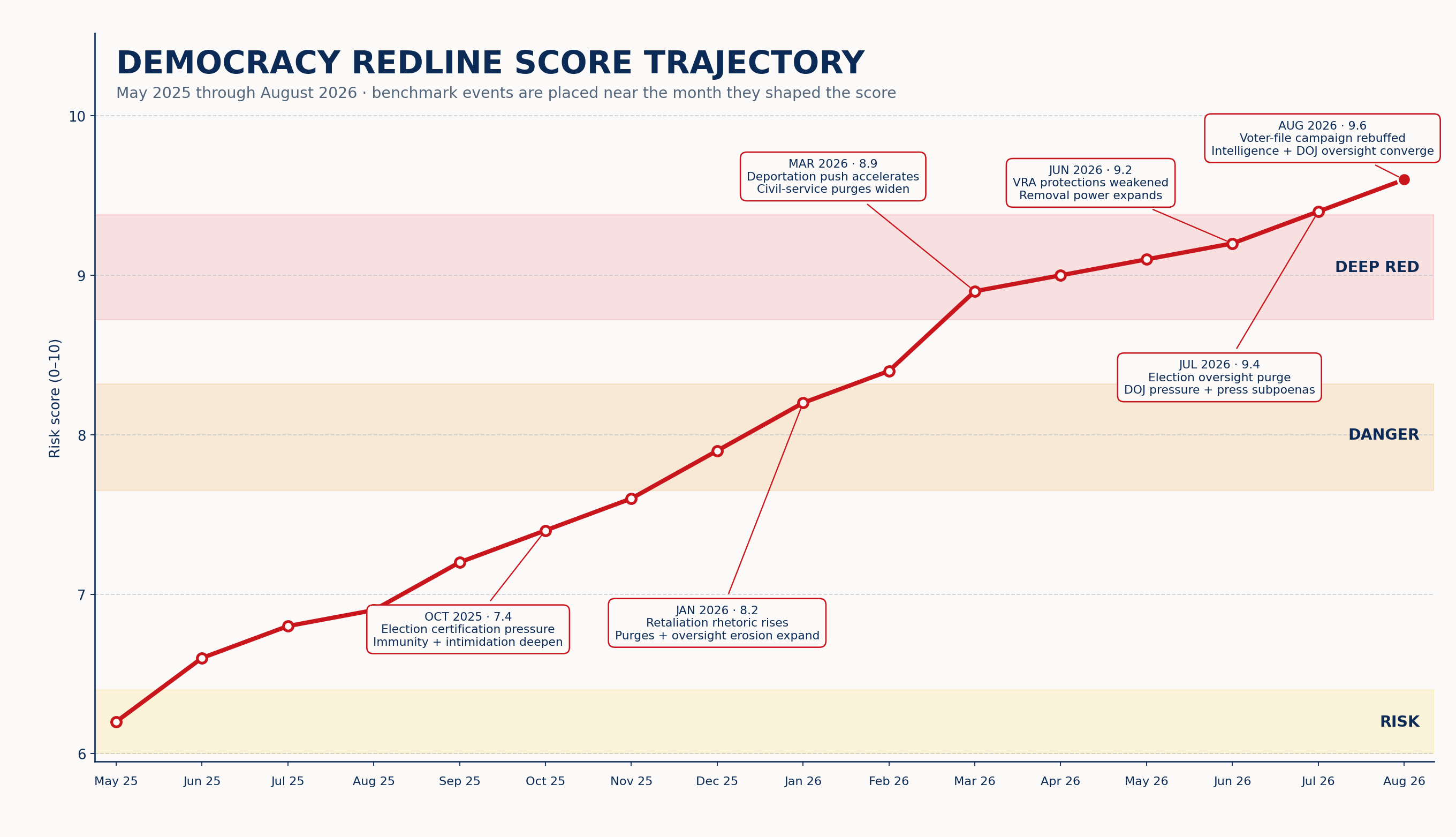
Historical trajectory context. January 2026 recorded 8.2 / 10.
What changed this month?
January marked a sharper turn from high-risk pressure into critical-range institutional stress. The month concentrated risk around independence of federal institutions, pressure on legal constraints, and continued personnel strain inside government service.
Top score drivers
Worsening: Pressure involving Federal Reserve leadership made independent institutions a central score driver.
Worsening: DOJ demands and lawsuits tested boundaries around state records and political adversaries.
Worsening: Departures among government lawyers raised concern about institutional capacity and internal restraint.
Active: Court rulings against some DOJ demands showed checks still functioning in important cases.
Category scorecard
| Category | Status | Interpretation |
|---|---|---|
| Institutional independence | Critical | Federal Reserve-related pressure made independence of key institutions a primary concern. |
| Rule of law and due process | Critical | Legal tools and record demands repeatedly tested the boundary between enforcement and pressure. |
| Executive power and accountability | High | The month showed broader attempts to shape or challenge independent centers of authority. |
| Election administration and federalism | High | DOJ pursuit of California voter details kept election-administration pressure in view. |
| Civil service and state capacity | High | Government-lawyer departures suggested strain inside the public-service layer. |
| Countervailing checks | Active | Federal judges still supplied direct constraints on several legal demands. |
Key evidence and benchmark events
- The administration opened a criminal investigation into Federal Reserve Chair Jerome Powell.
- The Supreme Court battle over Trump's attempt to remove Fed Governor Lisa Cook tested presidential control over independent institutions.
- A federal judge dismissed DOJ's lawsuit seeking California voter details.
- A federal judge blocked DOJ demands for records tied to Letitia James' lawsuits against Trump and the NRA.
- Government lawyers continued leaving federal service in unusually high numbers.
What moved the meter
The score moved higher because risks to institutional independence broadened while legal constraints were repeatedly tested. Court rulings still mattered as countervailing checks, but the overall trajectory remained upward.
What to watch next
- Independent institutions: Whether pressure on independent federal actors continued or receded.
- DOJ boundary testing: Whether lawsuits and record demands kept targeting state or adversarial institutions.
- Internal legal capacity: Whether departures from federal service impaired institutional restraint.
How this score is grounded
The score is a structured civic-risk judgment based on the public record for the monthly period. It is not a poll, a prediction, or a claim that every institution has failed. The report weighs documented events by severity, category, persistence, and whether multiple stress signals are moving together.
Observable public actions, court rulings, official statements, documented enforcement activity, and major reporting.
Why those events matter for democratic function, institutional independence, civil liberties, and rule-of-law constraints.
How the evidence affected the monthly risk assessment, especially when categories reinforced one another.
Evidence and source credibility
Backfilled formal reports rely on recovered archive content and the same source stack described in the methodology: official records, court actions, watchdog and civil-liberties sources, election-administration material, democracy-index references, and major journalism where it helps document public events.
Methodology note
Backfilled formal reports use the current Democracy Redline scoring framework to reconstruct earlier trajectory. Where recovered report text was available, this page uses that recovered content. These records are best read as trajectory documents that show sequence, persistence, and accumulation across months.

An independent monthly warning system tracking democratic stress in the United States.