The summer escalation became more durable.
July continued the upward move as war powers, immigration conflict, and domestic deployment pressures remained active.
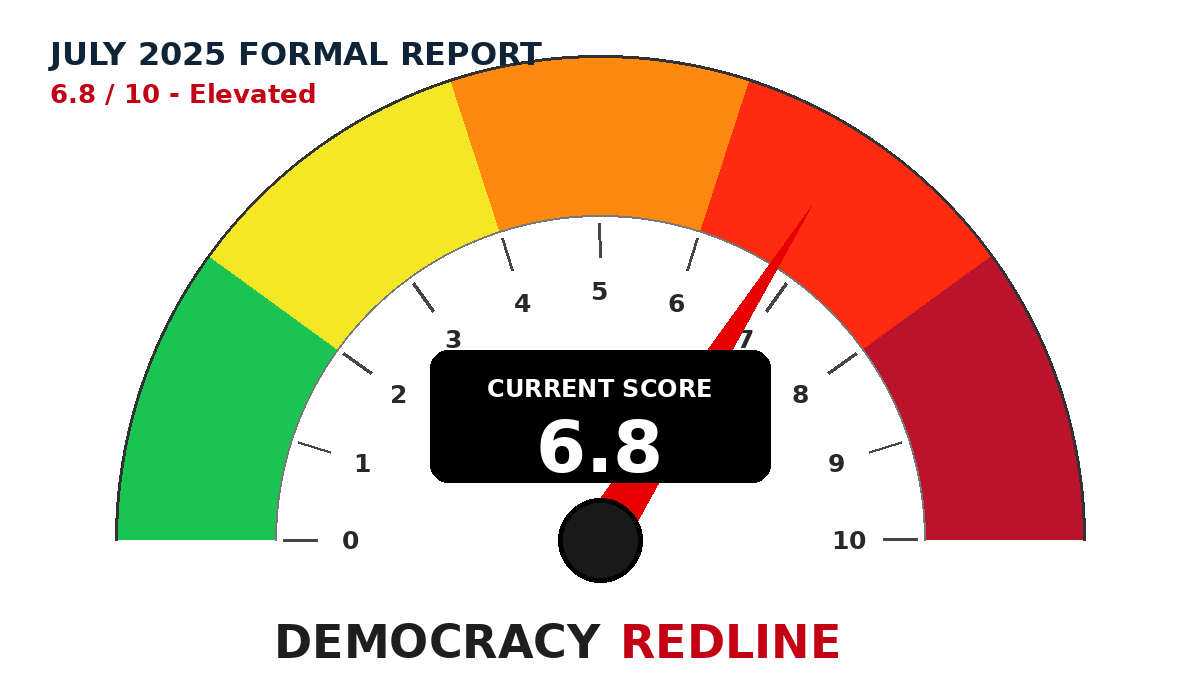
Retrospective backfilled summary. July 2025 recorded 6.8 / 10.
What changed this month?
This period mattered because the archive begins to show durability. A temporary spike is different from a sustained operating pattern. July’s modest increase reflects a risk environment in which domestic deployment, federal immigration conflict, and war-powers concerns remained central rather than fading after one news cycle.
Top score drivers
Derived from the existing archive summary for July 2025.
Derived from the existing archive summary for July 2025.
Derived from the existing archive summary for July 2025.
Derived from the existing archive summary for July 2025.
Category scorecard
| Category | Status | Interpretation |
|---|---|---|
| Rule of law and court compliance | Relevant pressure area | Referenced by the archive narrative where court orders, legal challenges, or deployment legality shaped the month. |
| Civil liberties and due process | Relevant pressure area | Referenced by the archive narrative through immigration, protest, due-process, or rights-related concerns. |
| Executive power and federal-state conflict | Relevant pressure area | Referenced where the month involved deployments, enforcement posture, or pressure on local authority. |
| Institutional checks | Countervailing / reactive | Courts, lawsuits, state resistance, public scrutiny, and local objections are treated as checks where the archive record identifies them. |
| Public legitimacy and normalization risk | Trajectory signal | The backfill weighs whether extraordinary conflict persisted long enough to become part of the operating baseline. |
Key evidence and benchmark events
This section uses the event language already present in the existing backfilled archive page for July 2025.
- Iran strikes moved war-powers accountability into the scoring environment. U.S. strikes on Iranian nuclear facilities and the global anti-war response added a foreign-policy and congressional-oversight dimension to the democratic-stress picture.
- Los Angeles troop deployment remained legally and politically active. The military deployment that began in June continued to shape July’s score, including public debate over whether troops were being used near the line between protection and domestic law enforcement.
- Immigration enforcement conflict expanded into litigation against Los Angeles. The Justice Department sued Los Angeles over sanctuary policies, tying the local protest and deployment crisis to a broader effort to pressure jurisdictions that resisted federal immigration enforcement.
- The month showed resilience and risk at the same time. Legal challenges, public criticism, and state resistance continued, but those checks were reacting to escalation after the fact rather than preventing it.
- The score rose less sharply because the crisis was sustained rather than newly transformed. July’s +0.2 movement reflects continuity and accumulation. The period confirmed that June’s escalation was not isolated, but it did not yet create the larger system-wide jump seen later.
What moved the meter
The meter moved from 6.6 to 6.8 because multiple stressors stayed active across the full window. July is a continuation month: still Elevated, still accumulating, and increasingly important as proof that the trajectory was becoming durable. This page is more substantive than the prior placeholder record, but it remains labeled as a retrospective backfill because it was reconstructed after the month had passed rather than published live during that period.
Source anchors
These links identify the public source anchors or project pages already associated with this backfilled month.
- Reuters: Anti-war protests after Iran strikes
- Reuters: Justice Department sues Los Angeles over immigration policies
- Reuters: National Guard troops remain part of LA dispute
- Reuters: Anti-war protests after Iran strikes
- Reuters: Anti-war protests after Iran strikes
- Reuters: Justice Department sues Los Angeles over immigration policies
- Reuters: Justice Department sues Los Angeles over immigration policies
- Reuters: National Guard troops remain part of LA dispute
- Reuters: National Guard troops remain part of LA dispute
- Return to archive
How this score is grounded
The score is a structured civic-risk judgment based on the archived record for the monthly period. It is not a poll or a prediction. It weighs documented signals by severity, persistence, category, and whether multiple stress signals moved together.
Observable public actions, court rulings, official statements, documented enforcement activity, and major reporting already referenced in the archive.
Why those events matter for democratic function, institutional independence, civil liberties, and rule-of-law constraints.
How the evidence affected the monthly risk assessment, especially when categories reinforced one another.
Methodology note
Backfilled records use the current Democracy Redline scoring framework to reconstruct earlier trajectory. They are useful historical context, but they remain separate from reports that were published live in their original month. The score should be read as a structured assessment of democratic stress across categories, not as a claim that any single event alone determined the month’s rating.

An independent monthly warning system tracking democratic stress in the United States.