The first clear acceleration in the backfilled sequence.
June rose as immigration raids, protest response, and federal deployment converged in the public record.
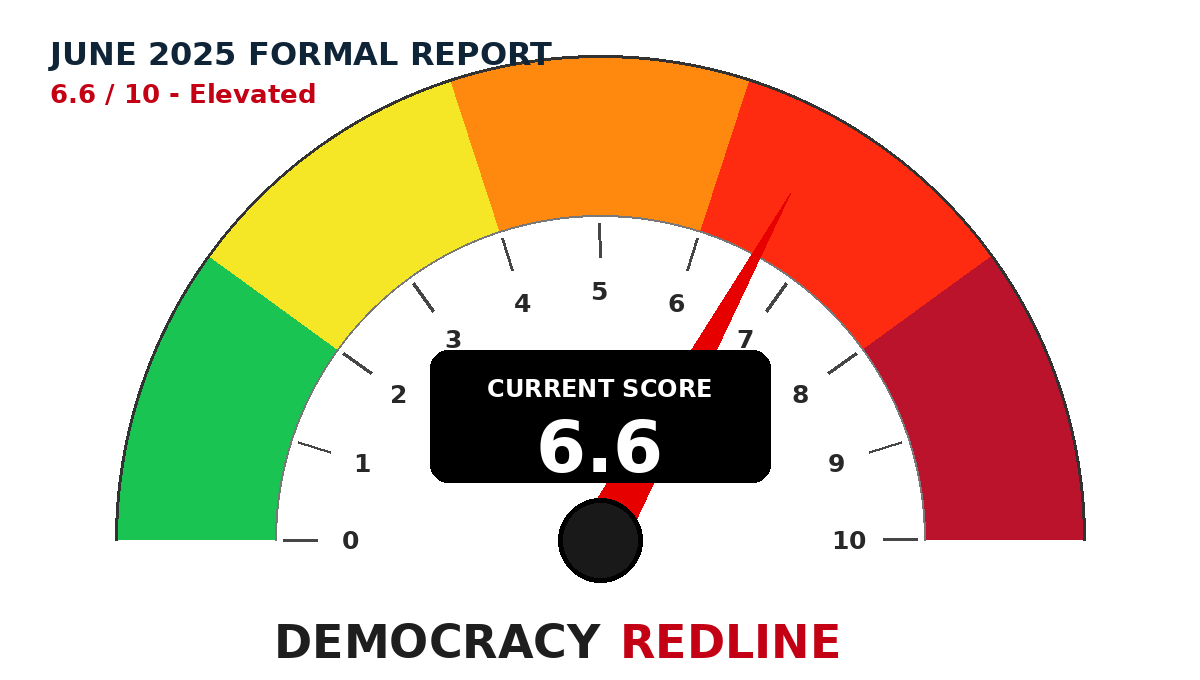
Retrospective backfilled summary. June 2025 recorded 6.6 / 10.
What changed this month?
This period mattered because several categories began reinforcing each other at once. Immigration enforcement increased civil-liberties pressure. The Los Angeles deployment tested federal power against state and local objection. Court decisions and legal challenges became part of the risk picture rather than a background process.
Top score drivers
Derived from the existing archive summary for June 2025.
Derived from the existing archive summary for June 2025.
Derived from the existing archive summary for June 2025.
Derived from the existing archive summary for June 2025.
Category scorecard
| Category | Status | Interpretation |
|---|---|---|
| Rule of law and court compliance | Relevant pressure area | Referenced by the archive narrative where court orders, legal challenges, or deployment legality shaped the month. |
| Civil liberties and due process | Relevant pressure area | Referenced by the archive narrative through immigration, protest, due-process, or rights-related concerns. |
| Executive power and federal-state conflict | Relevant pressure area | Referenced where the month involved deployments, enforcement posture, or pressure on local authority. |
| Institutional checks | Countervailing / reactive | Courts, lawsuits, state resistance, public scrutiny, and local objections are treated as checks where the archive record identifies them. |
| Public legitimacy and normalization risk | Trajectory signal | The backfill weighs whether extraordinary conflict persisted long enough to become part of the operating baseline. |
Key evidence and benchmark events
This section uses the event language already present in the existing backfilled archive page for June 2025.
- Supreme Court allowed revocation of temporary legal status for hundreds of thousands of migrants. Near the start of the coverage window, the Supreme Court allowed the administration to move forward with revoking temporary legal status for large groups of migrants while litigation continued, raising due-process and rights-protection concerns.
- Federal immigration raids triggered major Los Angeles protests. The period included protests against immigration raids in Los Angeles, with clashes between demonstrators, federal agents, and local authorities becoming a national flashpoint.
- National Guard deployment escalated the federal-state conflict. The administration deployed National Guard troops to Los Angeles over California’s objection, pushing the month from ordinary enforcement controversy into a constitutional and civil-military stress test.
- Active-duty military readiness entered the public debate. Public reporting that Marines were placed on alert, and later moved into the area, increased concern that domestic enforcement disputes were being militarized.
- Counterweights existed, but largely as resistance. State objections, lawsuits, local criticism, and public reporting provided democratic friction. But those checks did not prevent the deployment from becoming a defining pressure point for the month.
What moved the meter
The +0.4 increase reflects escalation across rights, executive power, public legitimacy, and political-intimidation categories. June was not simply about protests. It was about the federal government’s willingness to frame domestic unrest and immigration enforcement as a basis for extraordinary deployment. This page is more substantive than the prior placeholder record, but it remains labeled as a retrospective backfill because it was reconstructed after the month had passed rather than published live during that period.
Source anchors
These links identify the public source anchors or project pages already associated with this backfilled month.
- Reuters: National Guard deployment amid Los Angeles protests
- AP: Trump sending National Guard troops to LA-area protests
- Reuters: Supreme Court migrant-protection case summary
- Reuters: National Guard deployment amid Los Angeles protests
- Reuters: National Guard deployment amid Los Angeles protests
- AP: Trump sending National Guard troops to LA-area protests
- AP: Trump sending National Guard troops to LA-area protests
- Reuters: Supreme Court migrant-protection case summary
- Reuters: Supreme Court migrant-protection case summary
- Return to archive
How this score is grounded
The score is a structured civic-risk judgment based on the archived record for the monthly period. It is not a poll or a prediction. It weighs documented signals by severity, persistence, category, and whether multiple stress signals moved together.
Observable public actions, court rulings, official statements, documented enforcement activity, and major reporting already referenced in the archive.
Why those events matter for democratic function, institutional independence, civil liberties, and rule-of-law constraints.
How the evidence affected the monthly risk assessment, especially when categories reinforced one another.
Methodology note
Backfilled records use the current Democracy Redline scoring framework to reconstruct earlier trajectory. They are useful historical context, but they remain separate from reports that were published live in their original month. The score should be read as a structured assessment of democratic stress across categories, not as a claim that any single event alone determined the month’s rating.

An independent monthly warning system tracking democratic stress in the United States.