The backfilled record begins from an already elevated baseline.
May 2025 is the reconstructed starting point for the twelve-month backfill, already elevated before the sharper summer escalation.
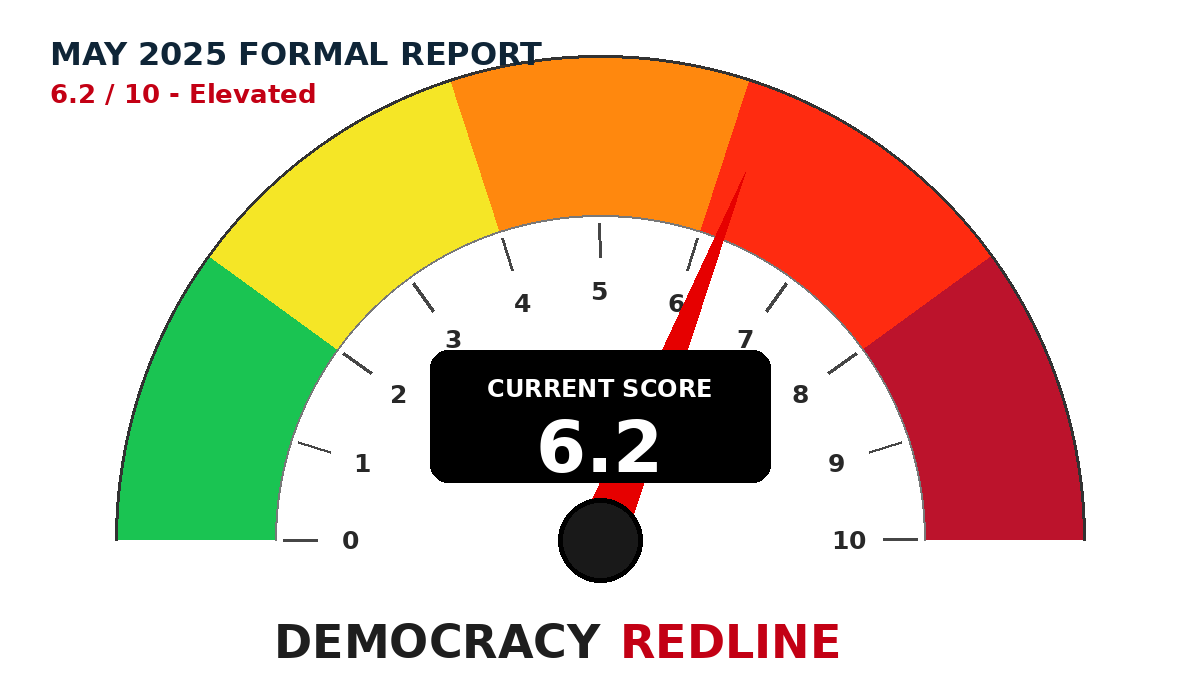
Retrospective backfilled summary. May 2025 recorded 6.2 / 10.
What changed this month?
This period matters because it establishes the floor for the later escalation. The score is already above normal warning levels, meaning the later Red Zone reading did not appear suddenly. It developed from a political environment where courts, executive power, immigration policy, and institutional independence were already colliding.
Top score drivers
Derived from the existing archive summary for May 2025.
Derived from the existing archive summary for May 2025.
Derived from the existing archive summary for May 2025.
Derived from the existing archive summary for May 2025.
Category scorecard
| Category | Status | Interpretation |
|---|---|---|
| Rule of law and court compliance | Relevant pressure area | Referenced by the archive narrative where court orders, legal challenges, or deployment legality shaped the month. |
| Civil liberties and due process | Relevant pressure area | Referenced by the archive narrative through immigration, protest, due-process, or rights-related concerns. |
| Executive power and federal-state conflict | Relevant pressure area | Referenced where the month involved deployments, enforcement posture, or pressure on local authority. |
| Institutional checks | Countervailing / reactive | Courts, lawsuits, state resistance, public scrutiny, and local objections are treated as checks where the archive record identifies them. |
| Public legitimacy and normalization risk | Trajectory signal | The backfill weighs whether extraordinary conflict persisted long enough to become part of the operating baseline. |
Key evidence and benchmark events
This section uses the event language already present in the existing backfilled archive page for May 2025.
- Court-compliance strain was already part of the public record. The archive starts from an environment in which federal court orders, immigration enforcement disputes, and due-process fights were becoming central tests of whether legal checks would restrain executive action.
- Rights and civic-standing pressure remained a primary driver. Immigration and due-process disputes served as an early pressure point for the civil-liberties category, even before the later deployment and protest-suppression events became more visible.
- Institutional independence was already under stress. This month is best read as a pre-surge warning point: the score captures an elevated operating environment rather than a single dramatic threshold event.
- Public legitimacy concerns were persistent rather than episodic. The backfill treats May as an accumulated-risk month, with public legitimacy and rule-of-law pressure carrying over from earlier conflicts.
- The month created the comparison base for June and July. Because the score begins at 6.2, the subsequent June and July increases show acceleration from an already strained position, not movement from a neutral baseline.
What moved the meter
May functions as the reconstructed baseline for the current backfilled arc. The meter did not jump because of one new event; it began elevated because multiple democratic-stress categories were already active at the start of the archive window. This page is more substantive than the prior placeholder record, but it remains labeled as a retrospective backfill because it was reconstructed after the month had passed rather than published live during that period.
Source anchors
These links identify the public source anchors or project pages already associated with this backfilled month.
How this score is grounded
The score is a structured civic-risk judgment based on the archived record for the monthly period. It is not a poll or a prediction. It weighs documented signals by severity, persistence, category, and whether multiple stress signals moved together.
Observable public actions, court rulings, official statements, documented enforcement activity, and major reporting already referenced in the archive.
Why those events matter for democratic function, institutional independence, civil liberties, and rule-of-law constraints.
How the evidence affected the monthly risk assessment, especially when categories reinforced one another.
Methodology note
Backfilled records use the current Democracy Redline scoring framework to reconstruct earlier trajectory. They are useful historical context, but they remain separate from reports that were published live in their original month. The score should be read as a structured assessment of democratic stress across categories, not as a claim that any single event alone determined the month’s rating.

An independent monthly warning system tracking democratic stress in the United States.