Score summary
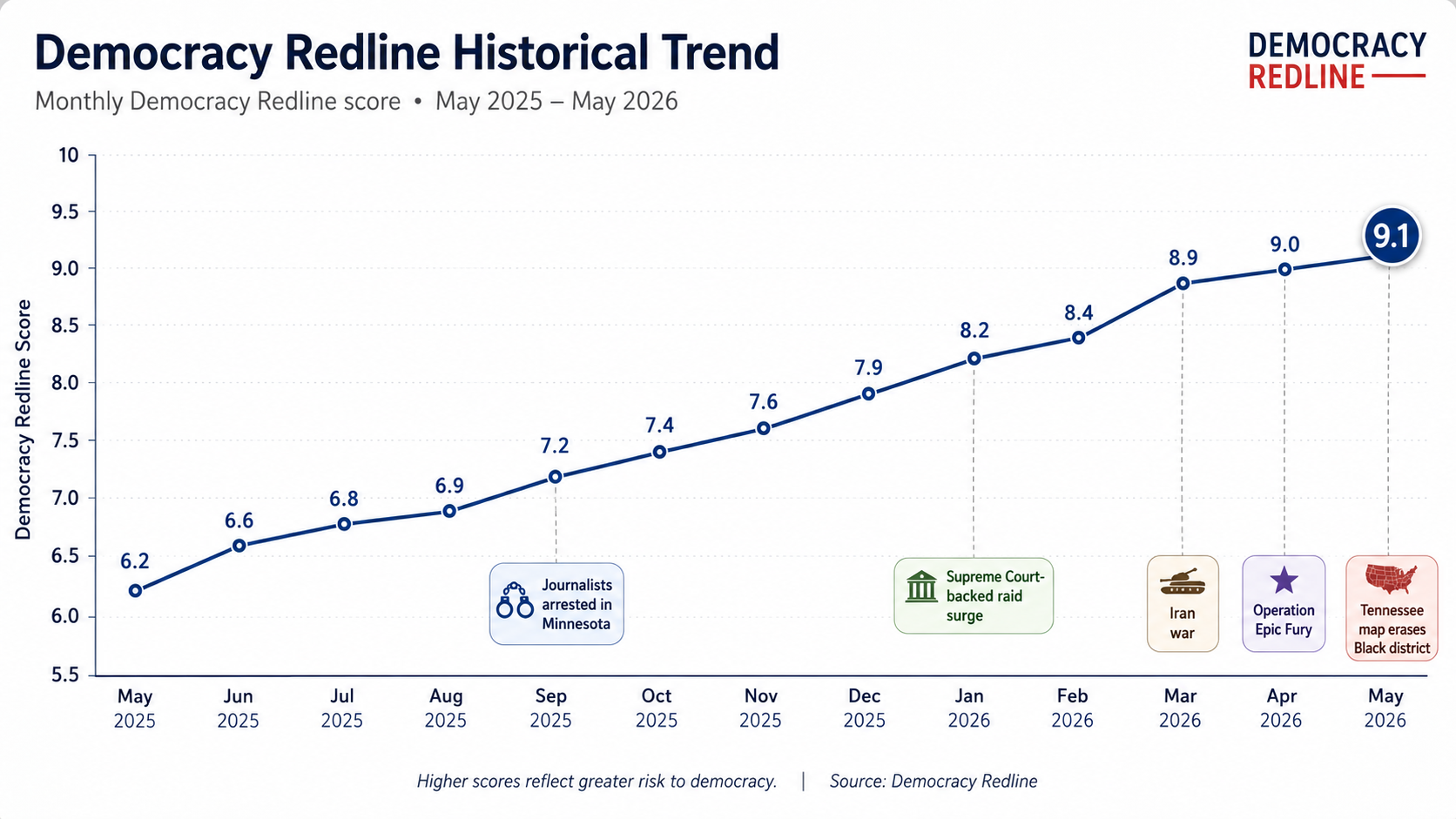
May did not reverse April’s warning. It deepened it.
The May score increased from 9.0 to 9.1. The movement was modest numerically, but important structurally: election fairness, due process, institutional oversight, and war-powers accountability all worsened further while courts mostly slowed deterioration rather than restoring broader balance.
Overall movement+0.1A small increase inside an already extreme risk band.
DirectionWorseningMay confirmed rather than corrected the April Red Zone crossing.
Core interpretationConvergenceMultiple high-risk categories stayed elevated at the same time.
How this score is grounded
The May score separates evidence from interpretation.
The 9.1 score is a weighted judgment based on observable public developments already cited in the May analysis. The report distinguishes the underlying fact pattern, the democratic-risk interpretation, and the score impact assigned to each major driver.
FactDocumented developments
Public reporting, court activity, official actions, and institutional decisions provide the evidence base.
InterpretationDemocratic function
The analysis asks whether those developments weaken elections, courts, due process, oversight, press freedom, or other safeguards.
ImpactCategory movement
May’s score movement came from category-level changes, especially election integrity, institutional checks, and military or intelligence neutrality.
Evidence and source credibility
Evidence anchors are grouped by institutional function.
Court and legal records
Used to evaluate court compliance, due process, detention review, and whether legal restraints are functioning in practice.
Official actions and government materials
Used to identify executive actions, agency behavior, enforcement posture, and oversight conflicts.
Major journalism and corroboration
Used when reporting is specific, corroborated, and tied to concrete institutional developments rather than rhetoric alone.
Countervailing signals
Judicial resistance and other democratic brakes are included so the score does not treat all activity as one-directional.
What changed this month
The danger became more cumulative.
The strongest negative pressure came from five overlapping developments: post-Callais election-structure erosion, broad court-order friction, due-process stress from detention fights, structurally worsening concerns about weaponized justice, and continuing Iran-related hostilities combined with weak war-powers oversight.
The judiciary remained the main brake
Courts continued to block or slow some aggressive moves involving voter data, no-bond detention, public-media funding, and Pentagon press restrictions.
The executive kept testing limits
Election administration, detention authority, DOJ power, media access, and war powers all remained under pressure at once.
The warning compounded
When several categories are already near the top of the scale, even incremental deterioration has outsized warning value.
Key evidence and benchmark events
The report rests on a small number of high-weight signals.
Elections
Tennessee redistricting after Callais
Made the election-fairness risk more concrete and moved the category from 8.7 to 9.0.
9.0
Courts
Accumulating court-order violations
Supported the conclusion that court-compliance stress was no longer isolated.
9.5
Detention
No-bond detention and habeas pressure
Kept due process in acute distress, even while courts continued to impose friction.
9.4
War powers
Iran hostilities and blocked congressional restraint
Produced the largest May category move and sharpened concerns about military accountability.
8.8
Brakes
Judicial resistance remained real
Public-media funding, voter-data demands, press access, donor privacy, and detention theories all saw meaningful pushback.
Brake
Countervailing signals
May was not scored as collapse.
May still produced meaningful democratic friction. Federal judges rejected some DOJ voter-data demands, appellate courts rejected the administration’s no-bond detention theory, a judge blocked the public-media defunding order, Pentagon press access was restored, and the Supreme Court strengthened donor privacy. These were real safeguards still functioning. The issue is that they did not reverse the month’s overall direction.
Methodology note
How to read this report.
This formal report uses the same Version 1.2 public model reflected in the live May analysis. The score is not a prediction of one discrete event. It is an index of democratic stress across nine categories, intended to show direction, intensity, and accumulation of warning signs over time.
The May finding should be read alongside the April Red Zone entry: May’s 9.1 score confirms that the April warning did not immediately reverse.