High Risk pressure became a durable trajectory.
November showed the archive moving firmly into High Risk territory as multiple categories began reinforcing one another.
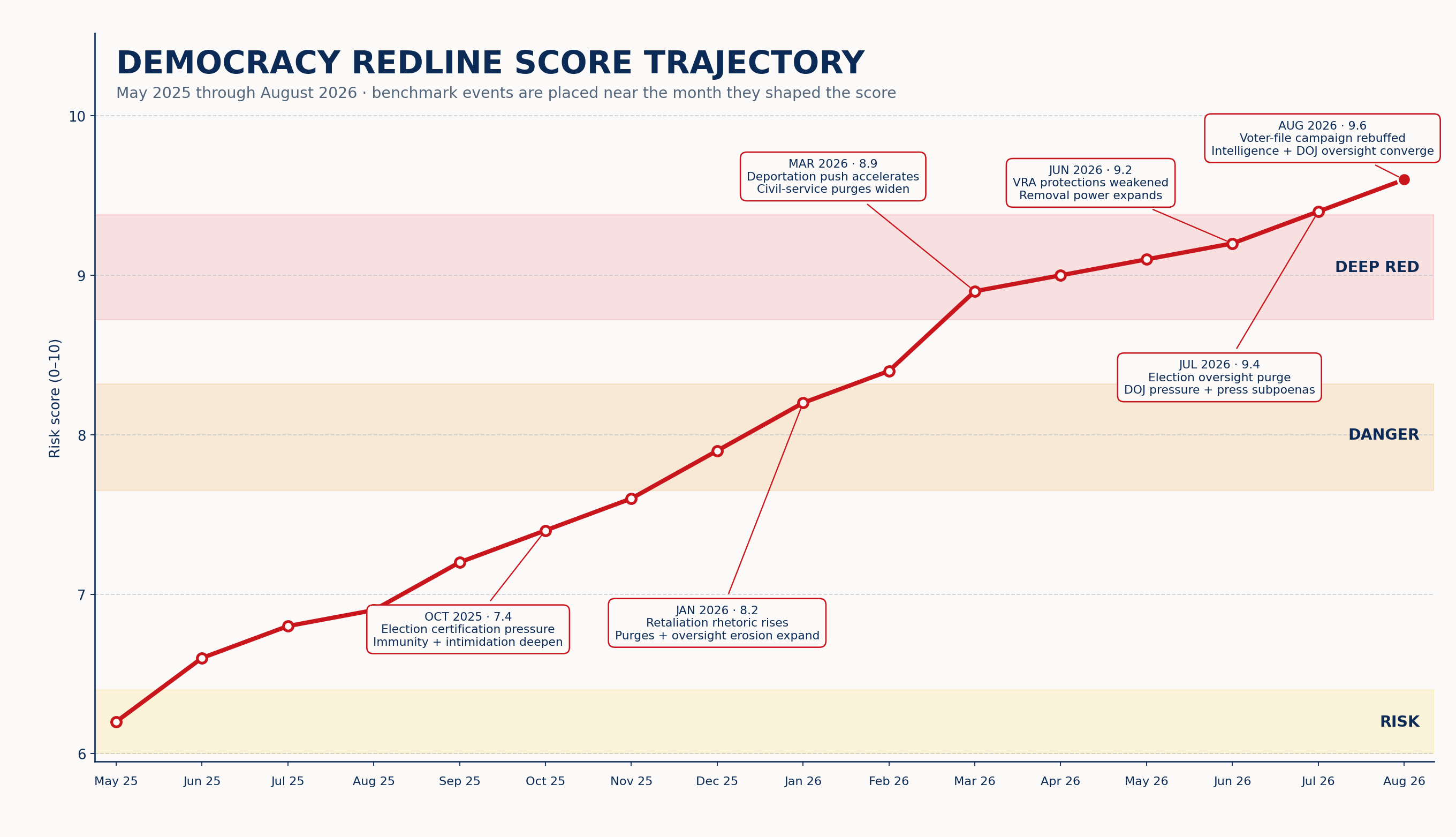
Historical trajectory context. November 2025 recorded 7.6 / 10.
What changed this month?
November showed the archive moving firmly into High Risk territory. The score reflected rising pressure across immigration authority, election administration, political retaliation concerns, and institutional behavior under executive pressure.
Top score drivers
Worsening: The TPS ruling kept immigration authority and legal-process concerns central to the month.
Worsening: Preparation of an elections executive order signaled pressure on voting rules before the 2026 cycle.
Worsening: Domestic-terror framing and pressure on institutions raised concern about punitive use of state power.
Present: The Illinois National Guard ruling showed courts still providing meaningful brakes.
Category scorecard
| Category | Status | Interpretation |
|---|---|---|
| Executive power and emergency authority | High | Pressure rose through deployment disputes and broad executive-branch assertions. |
| Rule of law and due process | High | Immigration and TPS litigation kept legal-process concerns elevated. |
| Election fairness and administration | High | Preparations around voting rules began to appear as an active score driver. |
| Civil liberties and civil society | High | Activist-network investigation framing increased concern about civil-society pressure. |
| Institutional independence | High | Law-firm accommodation suggested institutional behavior was adapting under pressure. |
| Countervailing checks | Active | Court intervention constrained one of the highest-risk deployment issues. |
Key evidence and benchmark events
- The Supreme Court let the administration revoke Temporary Protected Status for Venezuelans while litigation continued.
- Reuters reported a plan to investigate liberal groups and activist networks under a domestic-terror framing.
- The White House confirmed it was preparing an elections executive order aimed at mail voting and fraud prevention.
- A federal judge blocked the administration's deployment of federalized National Guard troops in Illinois.
- Law-firm accommodation after punitive executive pressure suggested retaliation was beginning to reshape institutional behavior.
What moved the meter
The score rose because multiple categories began reinforcing one another: immigration power, election rules, civil-society pressure, and institutional self-protection. The Illinois ruling kept the month from moving more sharply upward.
What to watch next
- Election-rule follow-through: Whether the planned elections executive order moved from preparation to implementation.
- Civil-society investigations: Whether investigatory framing widened or narrowed.
- Court constraints: Whether rulings like the Illinois order held as effective brakes.
How this score is grounded
The score is a structured civic-risk judgment based on the public record for the monthly period. It is not a poll, a prediction, or a claim that every institution has failed. The report weighs documented events by severity, category, persistence, and whether multiple stress signals are moving together.
Observable public actions, court rulings, official statements, documented enforcement activity, and major reporting.
Why those events matter for democratic function, institutional independence, civil liberties, and rule-of-law constraints.
How the evidence affected the monthly risk assessment, especially when categories reinforced one another.
Evidence and source credibility
Backfilled formal reports rely on recovered archive content and the same source stack described in the methodology: official records, court actions, watchdog and civil-liberties sources, election-administration material, democracy-index references, and major journalism where it helps document public events.
Methodology note
Backfilled formal reports use the current Democracy Redline scoring framework to reconstruct earlier trajectory. Where recovered report text was available, this page uses that recovered content. These records are best read as trajectory documents that show sequence, persistence, and accumulation across months.

An independent monthly warning system tracking democratic stress in the United States.