The score crossed into the low 7s as courts confronted federalized deployment.
September moved the archive into a more structurally serious zone as the legality of domestic deployment became a central risk question.
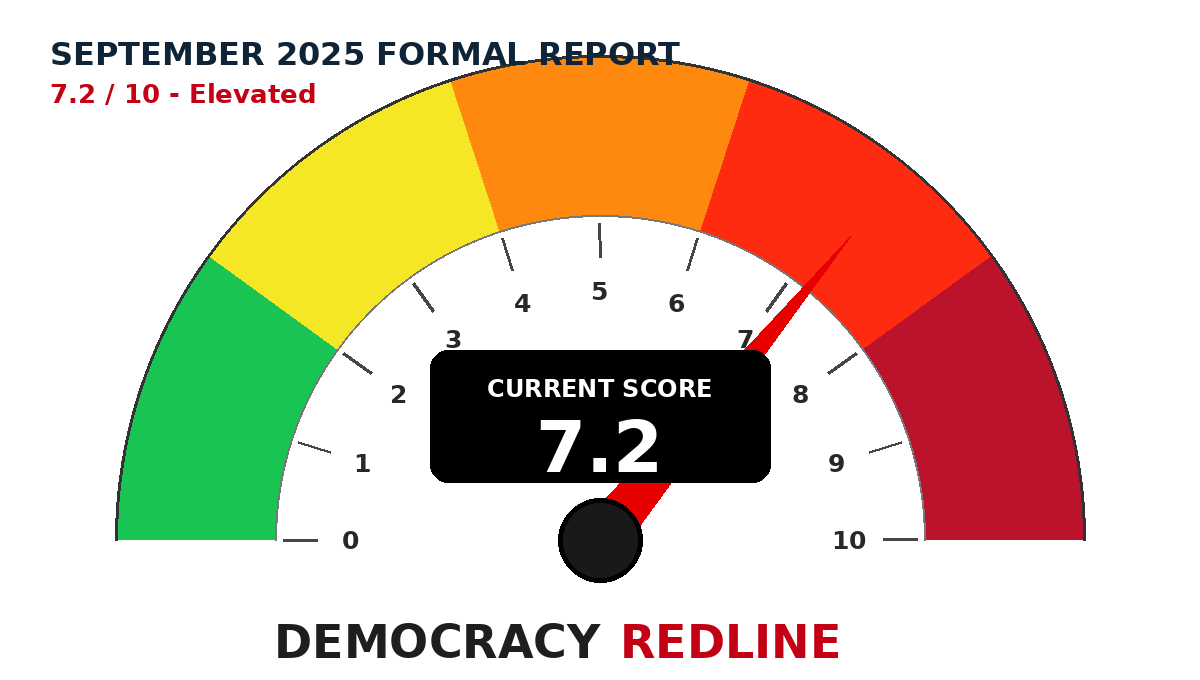
Retrospective backfilled summary. September 2025 recorded 7.2 / 10.
What changed this month?
This period mattered because the central question shifted from whether deployments were politically alarming to whether they exceeded legal limits. That is a more serious democratic-stress signal: when courts must decide whether the executive has used military force as a domestic policing instrument, rule-of-law and civil-military categories both become more acute.
Top score drivers
Derived from the existing archive summary for September 2025.
Derived from the existing archive summary for September 2025.
Derived from the existing archive summary for September 2025.
Derived from the existing archive summary for September 2025.
Category scorecard
| Category | Status | Interpretation |
|---|---|---|
| Rule of law and court compliance | Relevant pressure area | Referenced by the archive narrative where court orders, legal challenges, or deployment legality shaped the month. |
| Civil liberties and due process | Relevant pressure area | Referenced by the archive narrative through immigration, protest, due-process, or rights-related concerns. |
| Executive power and federal-state conflict | Relevant pressure area | Referenced where the month involved deployments, enforcement posture, or pressure on local authority. |
| Institutional checks | Countervailing / reactive | Courts, lawsuits, state resistance, public scrutiny, and local objections are treated as checks where the archive record identifies them. |
| Public legitimacy and normalization risk | Trajectory signal | The backfill weighs whether extraordinary conflict persisted long enough to become part of the operating baseline. |
Key evidence and benchmark events
This section uses the event language already present in the existing backfilled archive page for September 2025.
- A federal judge ruled the Los Angeles deployment crossed legal lines. Public reporting described a ruling that the administration’s use of troops in Los Angeles violated limits on military involvement in domestic law enforcement.
- The ruling created a counterweight but also confirmed the severity of the underlying action. Judicial restraint lowered some risk, but the need for such a ruling also validated why the deployment had become a democracy-risk event.
- Federal threats to send troops to additional cities widened the concern. The public debate was no longer limited to Los Angeles. Threats or plans involving other Democratic-led cities made the issue feel more like a governing model than an isolated response.
- Civil liberties and protest response stayed linked. The same enforcement-and-protest cycle continued to affect scores for civil liberties, political intimidation, and public legitimacy.
- The month prepared the ground for October’s High Risk reading. September’s +0.3 increase pushed the backfill into the 7s and made the subsequent October move into High Risk easier to interpret.
What moved the meter
The move to 7.2 reflects legal validation of the seriousness of the summer deployment crisis. Courts were still functioning as brakes, but the need for judicial brakes had itself become part of the warning signal. This page is more substantive than the prior placeholder record, but it remains labeled as a retrospective backfill because it was reconstructed after the month had passed rather than published live during that period.
Source anchors
These links identify the public source anchors or project pages already associated with this backfilled month.
- Reuters: Judge blocks use of troops for crime/law-enforcement role in California
- Guardian: Federal judge rules National Guard deployment illegal
- Reuters: Legal battles over National Guard deployments
- Reuters: Judge blocks use of troops for crime/law-enforcement role in California
- Reuters: Judge blocks use of troops for crime/law-enforcement role in California
- Guardian: Federal judge rules National Guard deployment illegal
- Guardian: Federal judge rules National Guard deployment illegal
- Reuters: Legal battles over National Guard deployments
- Reuters: Legal battles over National Guard deployments
- Return to archive
How this score is grounded
The score is a structured civic-risk judgment based on the archived record for the monthly period. It is not a poll or a prediction. It weighs documented signals by severity, persistence, category, and whether multiple stress signals moved together.
Observable public actions, court rulings, official statements, documented enforcement activity, and major reporting already referenced in the archive.
Why those events matter for democratic function, institutional independence, civil liberties, and rule-of-law constraints.
How the evidence affected the monthly risk assessment, especially when categories reinforced one another.
Methodology note
Backfilled records use the current Democracy Redline scoring framework to reconstruct earlier trajectory. They are useful historical context, but they remain separate from reports that were published live in their original month. The score should be read as a structured assessment of democratic stress across categories, not as a claim that any single event alone determined the month’s rating.

An independent monthly warning system tracking democratic stress in the United States.