1
Election Integrity worsened again
The Alabama map order converted the post-Callais rollback into another concrete June deterioration with immediate 2026 election consequences.
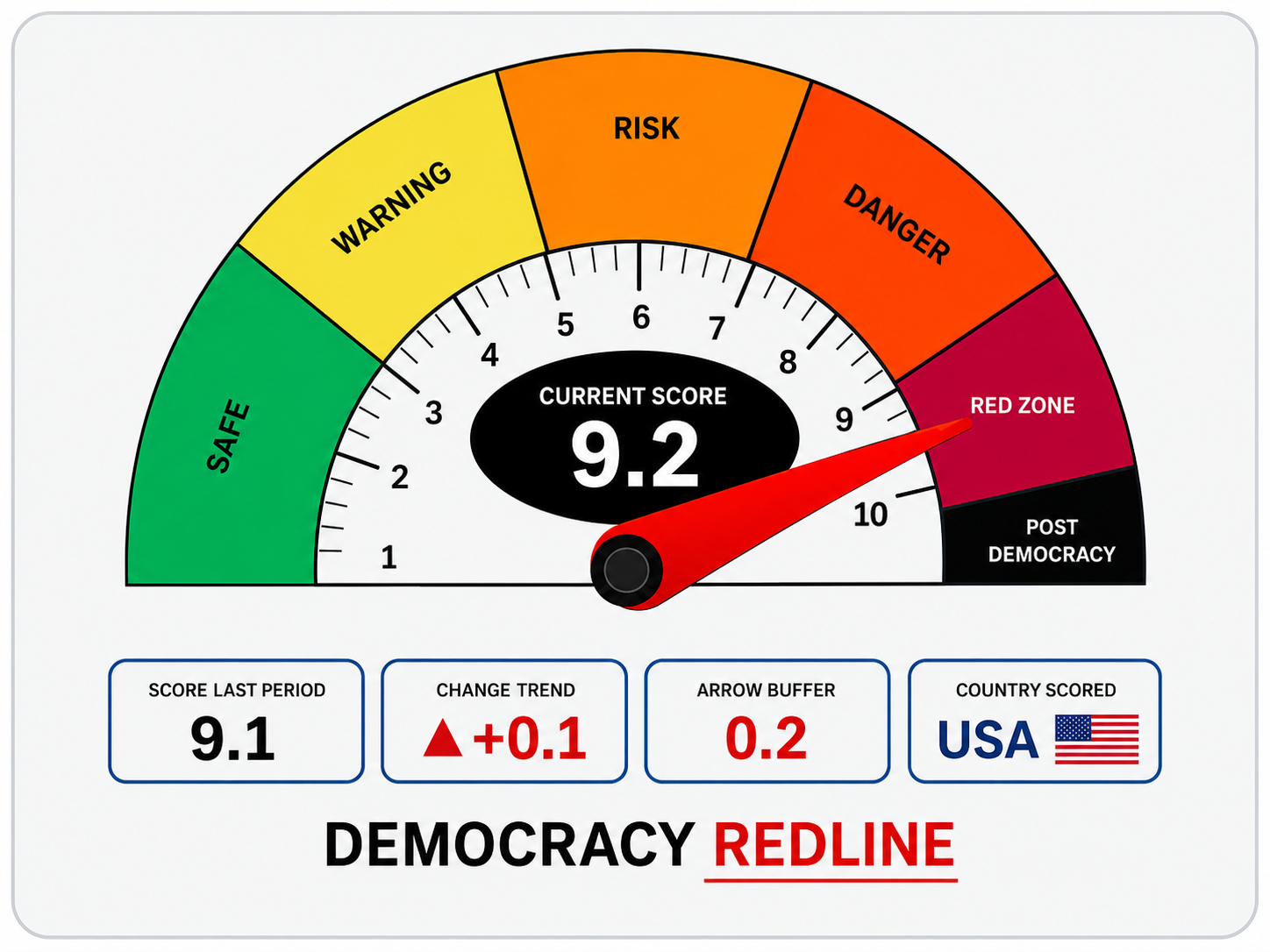
9.0 → 9.2

June did not reverse May's warning. It pushed the score from 9.1 to 9.2 as election integrity, due process, coercive state power, and military-intelligence neutrality all worsened further, even while courts still blocked several aggressive moves.
June's strongest negative driver was election structure. The Supreme Court allowed Alabama to use a map lower courts had found diluted Black voting power, reinforcing the post-Callais collapse of federal protections against racially dilutive redistricting. At the same time, the administration's March 31 election order remained under severe legal scrutiny for trying to federalize citizenship verification and mail-voting controls.
Due process also worsened. The mass no-bond detention fight continued across the federal courts while the June 3 workforce order removed procedural protections from thousands of senior policy-related federal employees. Intelligence and military neutrality deteriorated further as leadership churn, loyalty concerns, and weakened job protections hit the national-security state during ongoing Iran-related conflict.
Month-over-month acceleration
Structural election pressure worsened
Meaningful restraint, not reversal
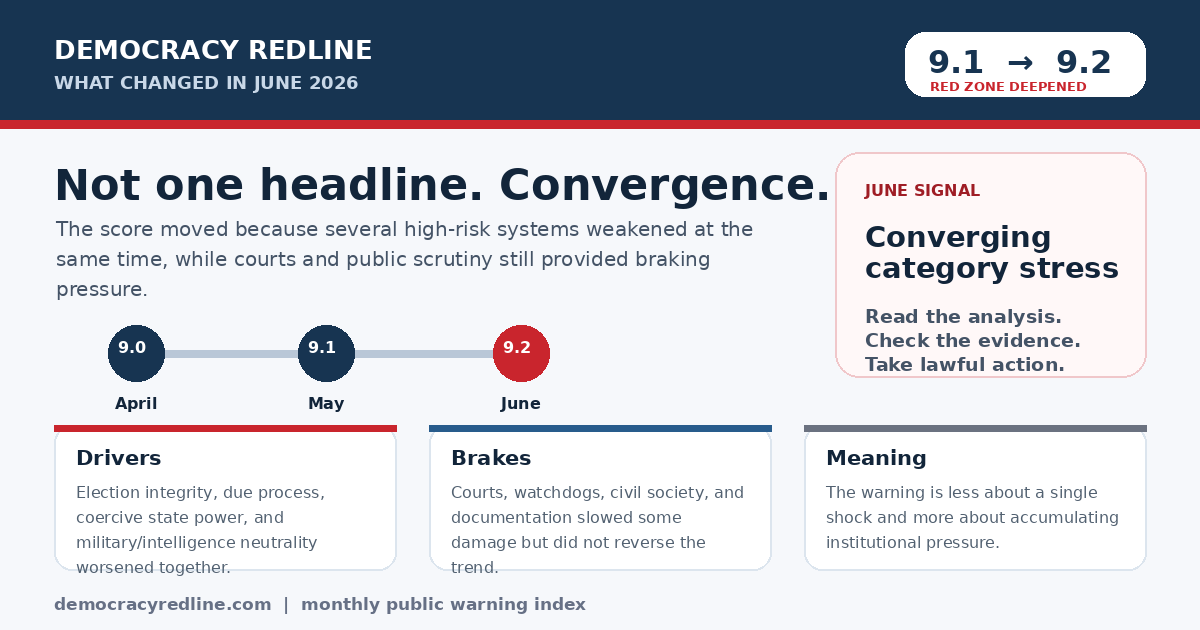
The published score moved from 9.1 to 9.2 because multiple high-risk categories deteriorated together. The warning is not that one event alone crossed a line. The warning is that election structure, due process, coercive state power, and military/intelligence neutrality all moved in the wrong direction while the system was already in the Red Zone.
This recurring monthly explainer is meant to make each score movement readable: what moved, what restrained the score, and what the public should watch next.
| Category | Weight | May | June | Move | June reading |
|---|---|---|---|---|---|
| Election Integrity & Peaceful Transfer | 20% | 9.0 | 9.2 | +0.2 | Alabama map order and unresolved federal election-order litigation reinforced structural risk. |
| Rule of Law & Court Compliance | 18% | 9.5 | 9.5 | 0.0 | Extreme-risk level held while courts continued restraining executive actions. |
| Habeas Corpus & Due Process | 14% | 9.4 | 9.5 | +0.1 | Detention and workforce due-process erosion kept the category in acute crisis. |
| Political Targeting / Weaponization of Justice | 12% | 9.5 | 9.5 | 0.0 | The failed fund did not normalize the larger selective-protection risk. |
| Institutional Checks & Anti-Corruption | 10% | 9.3 | 9.2 | -0.1 | Judicial brakes and preserved enforcement powers produced modest relief. |
| Press Freedom & Information Control | 8% | 9.1 | 9.1 | 0.0 | Pressure remained severe, but June did not clearly justify another upward move. |
| Coercive State Power & Policing Norms | 8% | 9.0 | 9.1 | +0.1 | Centralized personnel control and enforcement pressure nudged the category higher. |
| Civil Society & Associational Freedom | 6% | 8.5 | 8.4 | -0.1 | Protective rulings created modest relief without restoring safety. |
| Military / Intelligence Neutrality | 4% | 8.8 | 9.0 | +0.2 | Loyalty pressure and weakened protections elevated independence risk. |
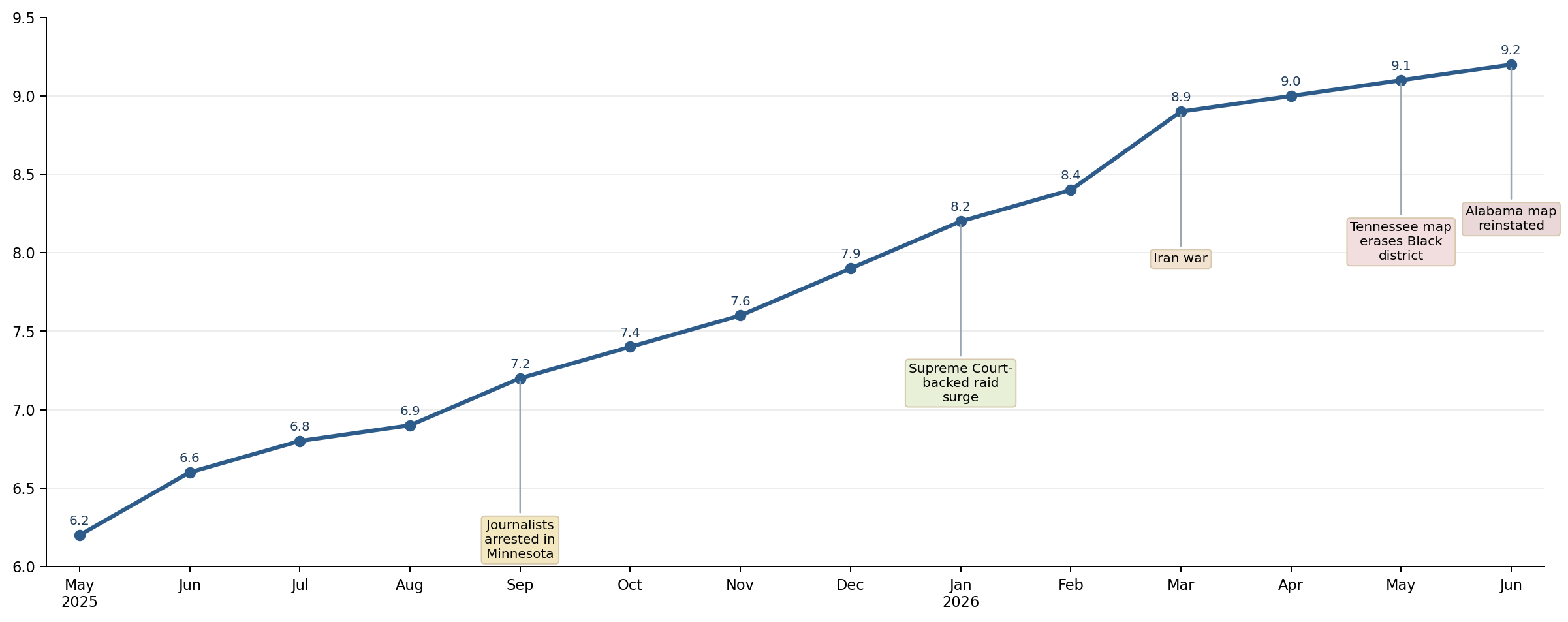
The chart is used as a continuity record. It helps readers understand sequence, persistence, and acceleration rather than treating any month as an isolated headline.
The Alabama map order converted the post-Callais rollback into another concrete June deterioration with immediate 2026 election consequences.
The no-bond detention fight kept splitting the circuits while the June 3 workforce order removed long-standing procedural protections from thousands of senior federal employees.
DNI turnover, loyalty concerns, and weaker protections for senior national-security personnel made professional independence look more vulnerable in June.
The Anti-Weaponization Fund collapsed under judicial and bipartisan pressure, but the larger accountability asymmetry around insider protection and selective scrutiny remained intact.
June's strongest counterweights were the injunction against ideological grant conditions and the collapse of the Anti-Weaponization Fund.
June still produced meaningful democratic friction. Courts blocked ideological conditions on federal funding streams. The Anti-Weaponization Fund was stopped before the administration could disburse money through a highly questionable patronage mechanism. These developments matter because they show the judiciary can still impose limits. But they also illustrate the broader problem: the warning system is increasingly measuring how much damage accumulates before the brakes engage.
An independent monthly warning system tracking democratic stress in the United States.